Monday, September 30, 2013

Diversity 101: Blurring the Lines Between Familiar and Foreign

Part II—A Focus on Dialogue

Contributed to CBC Diversity by Uma Krishnaswami

My Personal Connection
The books you read as a child are as real as the places you live in or the people around you. They whisper to you of the possibilities the world can offer, like mental pathways into your own as-yet-unlived future.

In that category, Rumer Godden gave me permission to write. Kipling both enchanted and troubled me; only many years later did I understand my own need to write about the country he depicted with his strange colonial mixture of tenderness and disdain. But as a child of the late 1950s growing up in India, I cut my reading teeth on Enid Blyton.

I learned a lot from Enid about humor, family, friendships, and the pleasure of racing along a swiftly unfolding plot. Now, thinking back, I am pretty sure that I also learned how not to write dialogue.

Wednesday, September 25, 2013

Checking Boxes and Filling Blanks: Diversity and Inclusion in Children’s Literature

Guest post by educator and writer, Cory Silverberg.


Lee & Low Books'
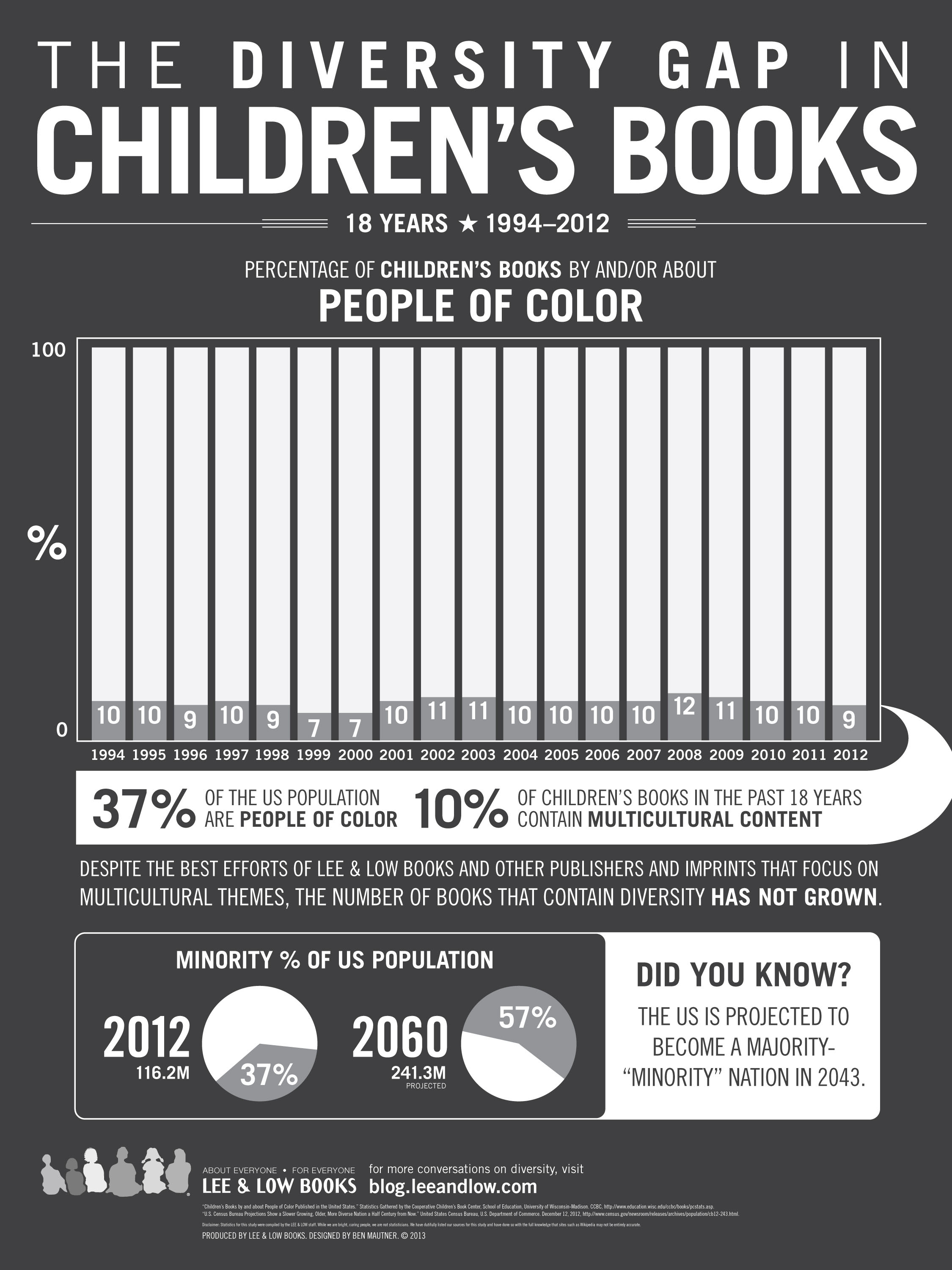
Diversity Gap in Children's Books Infographic
The publisher Lee and Low recently mobilized social media (through the nifty infographic on the left) to jumpstart a discussion of diversity in children’s literature. No surprise to anyone who is paying attention, while the US continues to undergo a significant demographic shift, diversity in children’s books is not reflecting what we the people look like today.

When we grow up not finding ourselves represented in popular media and educational curricula it becomes just a little harder to creatively imagine our futures, to explore our identities, to try on different ways of being; all of which are essential aspects of development. 

Shame thrives in invisibility and silence. This is why representation is a critical aspect of diversity work. 

But we need to also be mindful of how easily a complicated idea like diversity becomes code for one flattened out thing. That thing is usually the visual representation of race. As authors and educators, editors and publishers, we need to notice how this is missing the forest for the trees.  

So as publishers start identifying even more specific ‘diversity markets’ and begin to make editorial “requests” to meet them, it seems like a good time to consider both the forest and the trees, and think about whether there’s a way to tend to both.

To accomplish this we need to think not only of diversity but also of inclusion.

Monday, September 23, 2013

CBC Diversity Newsletter: September 2013 v. 2


Diversity 101: Blurring the Lines Between Familiar and Foreign

Part IA Focus on Narrative

Contributed to CBC Diversity by Uma Krishnaswami

My Personal Connection
Back in the last century, when I dreamed of writing for young readers, the conventional wisdom about weaving foreign languages into fiction written in English went like this:

Don’t.

The stories I longed to write spanned continents. My characters often spoke in two languages, sometimes with varying degrees of fluidity. My narratives demanded a mixing of languages, reflecting the hybridity I was trying to show.

I plunged in, wanting to find my own answers. I wrote a lot of bad stories that earned the rejections they deserved. I kept asking myself, how can I represent this linguistic and cultural material while being truthful to the stories I’m trying to tell?

Friday, September 20, 2013

Is the Race Card Old School?

An It's Complicated! — Authentic Voices guest post by author, Mitali Perkins.

When my book Rickshaw Girl (Charlesbridge) came out, one reviewer said I was “drawing on my cultural roots” to tell the story.

I winced when I read that line.

I was writing about Naima, the Muslim daughter of an impoverished rickshaw puller in Bangladesh. My grandfather was a Hindu landowner who exploited people like Naima. The rift between me and my character was almost as wide as a daughter of a slave-owner writing about the daughter of a slave. Sure, we’re both Bengali, so we share a language and other cultural commonalities. But why is race the primary authenticity card when it comes to granting storytelling permission? What about power, gender, class?

The bottom line is that all fiction crosses borders. Age: middle-aged people write about children. Gender: women write about boys; men write about girls. Class: suburbanites write about inner-city kids.

If we don’t write an imagined life, we craft memoir.

Does that mean anybody can write anything when it comes to fiction? It must, with caveats. Because what an author learns before the age of seven does matter in fiction.

Thursday, September 19, 2013

"I Want to Write What I Know"

An It's Complicated! — Authentic Voices guest post by author, Bil Wright.

“Write what you know!” Isn’t that what English teachers, writing instructors and even guest authors encourage beginning writers to do? Many young writers, eager to begin to unravel the mystery of how to tell a story “successfully” hold onto this advice as a foundation for their writing careers whether it be professionally, academically or writing for their own enjoyment. Certainly this adage provides a certain comfort level; writing about what is familiar almost guarantees, if nothing else, a level of credibility and even authenticity, doesn’t it? And certainly, for any writer wanting to make a deep connection with his/her reader, authenticity is a quality that is highly desirable. So then does that mean I should stay away from writing about topics or characters, indeed people who are less familiar to me? Perhaps I should not include them in my computer created world, lest I fall short of making them totally believable to my reader. Perhaps I should compile a list so that I’m careful to avoid these topics and characters as I proceed to tell my stories.

Wednesday, September 18, 2013

Authentically Me

An It's Complicated! — Authentic Voices guest post by author, Sharon G. Flake.

Growing up I did not see the value in being my authentic self. I was skinny, long-legged, and shy with big rabbit teeth.  Some adults and kids even called me Olive Oyl (Popeye’s Girlfriend) —enough said?
 

I remember wanting to be like my neighbor Yolonda. She could wear a blanket and look red-carpet ready.  I on the other hand, could never quite make fashion work, even today.

By middle school comparing myself to others was a fine art.  There was the blond I sat next to who had the most exquisite handwriting. For years I tried to emulate it.  In high school there was Pam. She absorbed information like a sponge.  Earning high A’s with ease or so it seemed.  I would study until my brain froze, only to end up with a lack luster B or C.

Thank God for my freshmen college English class.  Before then, I do not recall feeling one-way or the other about writing. Yet somehow my professor lit a flame in me. No longer did I need to be a carbon copy of others, at least on paper.  My writing was opinionated, fearless, and political. I was determined to use my work to give voice to the powerless.  And because I loved the community I grew up in, I never hesitated to draw on its strengths, challenges and uniqueness.